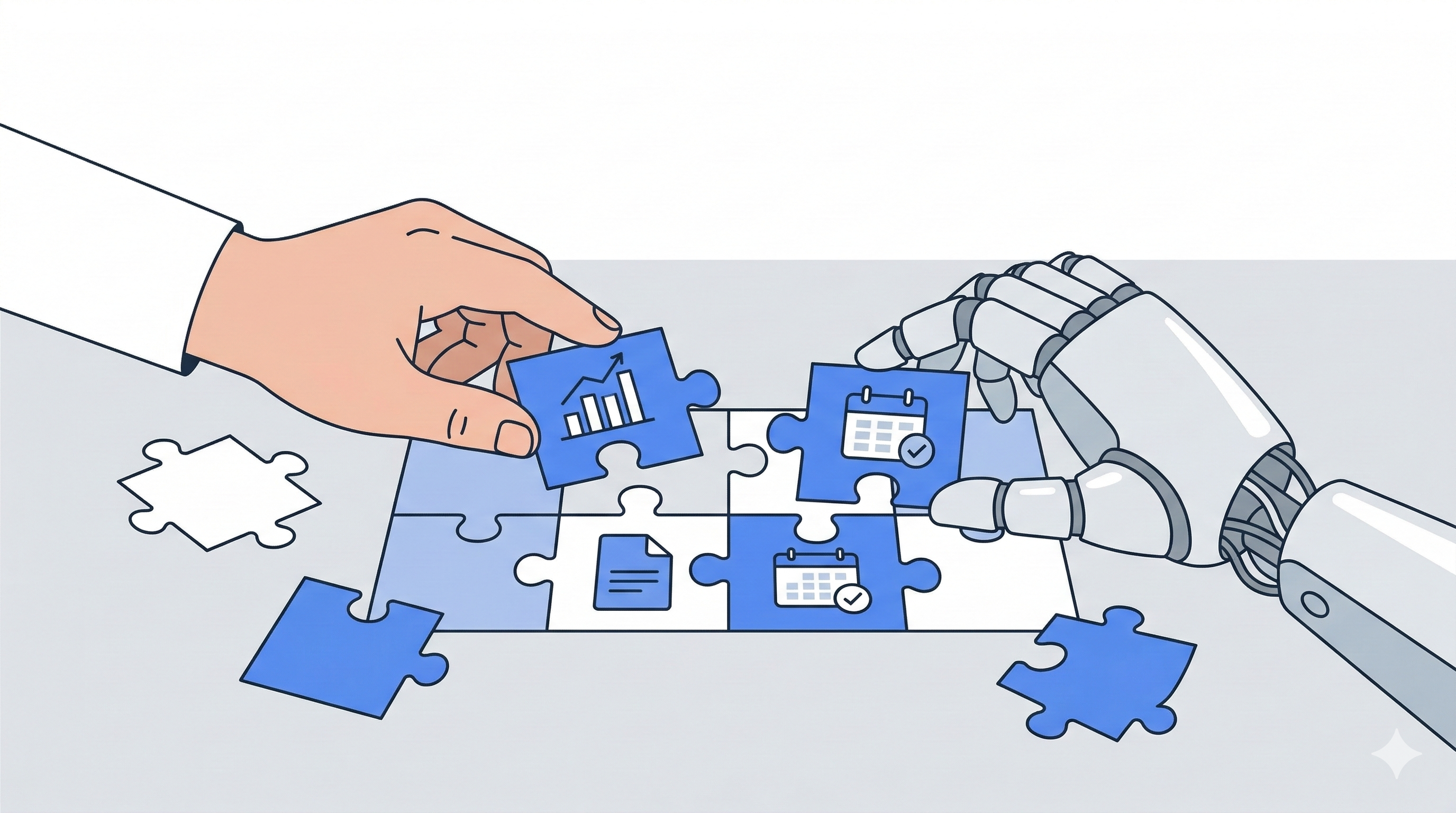
In February 2026, Microsoft AI CEO Mustafa Suleyman stated that most white-collar professional tasks are likely to reach human-level automation within 12 to 18 months.
He didn’t talk about eliminating professions. He talked about automating tasks. That distinction changes everything.
What gets automated
Legal analysis and document review. Accounting and financial processing. Project management. Marketing and campaign execution. Software development. In short: everything done in front of a screen is in the line of fire.
The clearest signal comes from software engineering: in some environments, AI already generates the majority of code. The relationship between professionals and technology has tangibly shifted in the last six months — from using tools to collaborating with them continuously.
What doesn’t get automated
AI automates execution. It doesn’t automate accountability.
Outcomes still need an owner. Decisions still demand human judgment. Risk, ethics, compliance, and prioritization remain human functions. That doesn’t change with AI — it becomes more important.
Organizations that understand this will redesign roles deliberately: shifting human effort from execution toward oversight, integration, and decision quality. Those that don’t will react too late.
What leaders should do today
First: measure impact in months, not years. Second: evaluate roles at the task level, not by title. Third: start reskilling and governance now, because if you wait it’s already late. Fourth: organizations already integrating AI into daily workflows will adapt far faster than those still treating it as an experiment.
AI is moving from assistant to executor in office work. What remains decisively human is responsibility for outcomes. Organizations that act early, design intentionally, and govern seriously will not be displaced by AI — they will be the ones deciding how it’s used.