Artificial intelligence is here to stay. It is already part of our lives, our work, how we produce, and how we communicate. And it evolves at an incredible speed: what was experimental six months ago is routine today. A technology with that reach has to be regulated. Or rather, as I wrote in my reading of Magnifica Humanitas, it has to be disarmed: stripped of its power to deceive in the hands of those who use it in bad faith, those who seek to pretend to be what they are not and take what does not belong to them.
Today I want to focus on one specific part of the European Union’s AI Act: Article 50, whose transparency obligations have applied since August 2, 2026. The Regulation itself entered into force on August 1, 2024; these obligations have only just started to apply.
What the law requires
Regulation (EU) 2024/1689, known as the AI Act, classifies AI systems according to their level of risk. Many of its best-known obligations concern high-risk systems, but Article 50 addresses something different: transparency obligations for certain AI systems in four specific situations. Depending on the case, responsibility falls on the provider of the system or on the deployer using it in a professional context.
The four obligations, according to the European Commission’s official guidelines published on July 20, 2026:
1. Systems that interact directly with people. Providers must design them so that people are informed that they are interacting with AI, unless that is obvious to a reasonably well-informed, observant, and circumspect person, taking the context into account. No more, for example, support bots pretending to be “Laura from customer service” when nothing makes it clear that a machine is behind the conversation.
2. Technical marking. Providers of systems that generate or manipulate synthetic audio, images, video, or text must make their outputs detectable as artificially generated or manipulated and mark them in a machine-readable format, as far as technically feasible. There are exceptions, including standard assistive editing functions that do not substantially alter the input or its meaning. There is also an important transition: generative systems placed on the market before August 2, 2026 have until December 2, 2026 to comply with this technical obligation. This duty falls on providers; it does not mean that every user must build their own marking mechanism.
3. Emotion recognition and biometric categorization. Deployers of these systems must inform the people exposed to them, in addition to complying with applicable data-protection rules.
4. Deepfakes and public-interest text. A deployer using an AI system to generate or manipulate image, audio, or video content that constitutes a deepfake must disclose that the content has been artificially generated or manipulated. For evidently artistic, creative, satirical, fictional, or analogous works, that disclosure may be made in a way that does not hamper the display or enjoyment of the work. And when AI-generated or manipulated text is published to inform the public on matters of public interest (for example, economic, financial, political, scientific, or cultural developments) a transparency obligation also applies, unless the content has undergone human review or editorial control and a natural or legal person holds editorial responsibility for the publication.
The information required by these obligations must be provided clearly and distinguishably, no later than the person’s first interaction with or exposure to the system or content.
Penalties for non-compliance can reach, depending on the case, up to €15 million or, for companies, up to 3% of worldwide annual turnover. Enforcement is subject to proportionality requirements, including those applicable to smaller businesses.
The exception that matters: editorial responsibility
For those of us who publish text, the exception for human review and editorial responsibility is fundamental. The law itself provides that labelling is not required when the content has undergone human review or editorial control and a natural or legal person holds editorial responsibility for its publication.
The Commission clarifies in its official FAQ that the review has to be substantive. A spelling, grammar, or purely formal check is not enough. Human review means deliberately examining the substance of the content with relevant knowledge and professional judgment; editorial control means having real authority to approve, change, or reject the substance of the text, including fact-checking and assessing the trustworthiness of sources. Editorial responsibility means holding ultimate legal responsibility for what is published.
That is the standard I try to apply on this blog. Every CRP.gi article begins with a real experience, concern, or thesis of mine, is developed with AI assistance, and is reviewed by me line by line before publication. I verify relevant claims against their sources and decide what stays, what changes, and what gets removed. When those conditions are met, Article 50’s text-labelling obligation does not apply. Even so, I disclose the use of AI as an editorial support tool at the foot of every article. I would rather transparency not depend on whether a legal exception requires me to say so.
How I use AI day to day
Let me tell you what is behind an article like this one. AI helps me conceptualize: turning a loose idea into a structure that holds together. It helps me search, compare, and cross-check sources that used to take hours of my time. And that gives me back the most valuable thing: time to notice the details that used to stay buried under drafting and information gathering.
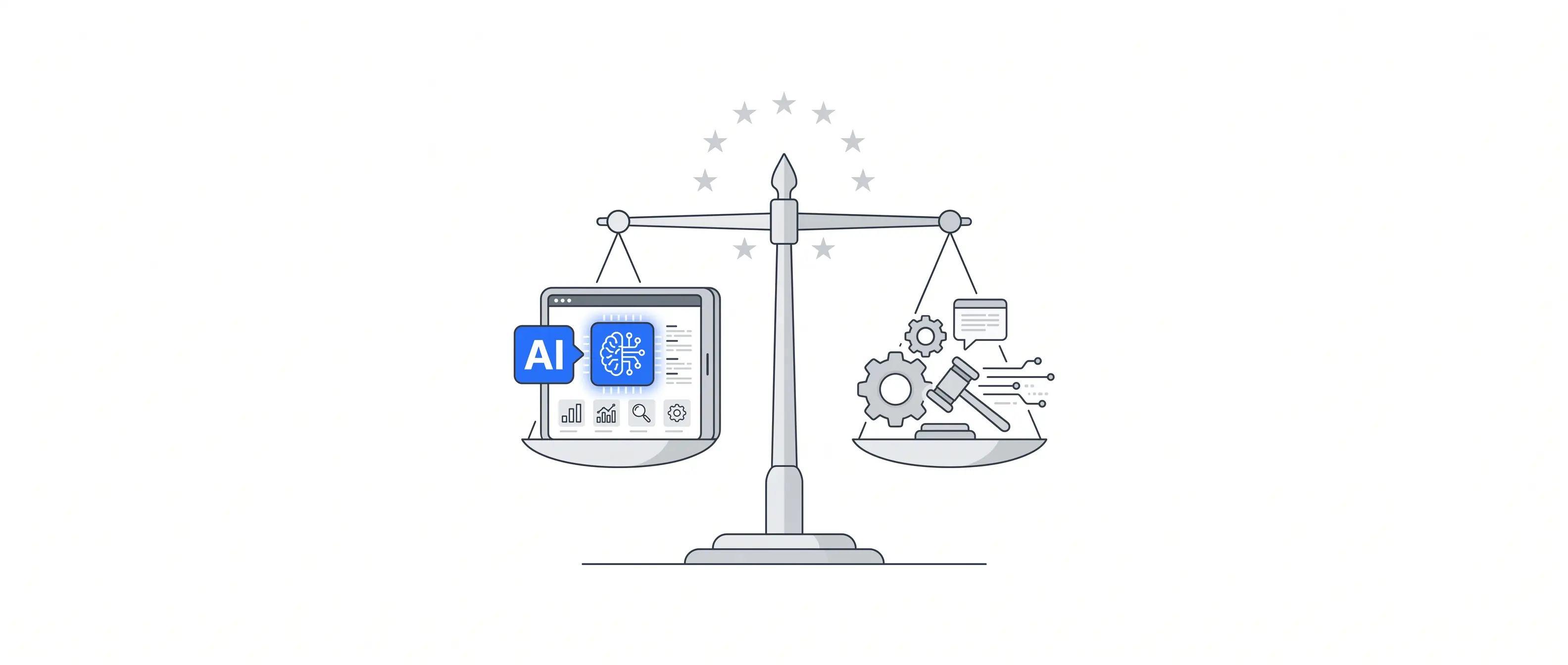
The same applies to the image that accompanies each article. For every publication, I write a prompt for Gemini, using its Nano Banana image-generation capabilities, that describes the article’s central idea, the concept I want to represent, and the visual direction. That prompt becomes the basis for generating the image. Here too, AI executes, but the idea, direction, and final selection remain part of my editorial process.
This process is grounded in Rick Dakan and Joseph Feller’s AI Fluency Framework and its four human competencies: Delegation, Description, Discernment, and Diligence. In the article on knowledge collapse, I added, for the collective problem I was analyzing, a fifth dimension of my own: Dissemination. Dakan and Feller’s framework has four Ds; Dissemination is my extension for a different question: what we do with knowledge after we acquire it.
The first four help me collaborate with AI without surrendering judgment: deciding what to delegate, describing precisely what I need, discerning what I receive, and exercising diligence by verifying before I publish. The fifth explains why I share what I learn so that it may be useful to someone else.
Article 50 does not turn that process into a legal obligation, nor does it punish the use of AI for research, drafting, or creation. What it does is establish specific transparency obligations for certain systems and content. And in the case of public-interest text, it explicitly recognizes the difference between an automated output with no editorial control and content that has undergone substantive human review under editorial responsibility.
Let’s keep using AI, but well
Article 50 does not prohibit using AI to produce. It requires transparency in specific situations: informing people when they are interacting with AI when that is not obvious, enabling the technical detection of synthetic content, informing people about certain biometric systems, and disclosing deepfakes and certain AI-generated or manipulated texts.
I prefer to go one step further. Say where the machine was involved, review what it produced, and put my own name behind what I ultimately publish.
Let’s keep using AI. Let it amplify our abilities, not help us fake abilities we do not have. Let it give us time for the details, for judgment, and for making a real contribution to the community we belong to. The difference is not only in the tool, but in who signs at the end and what they are prepared to answer for.
Legal sources: Article 50, Regulation (EU) 2024/1689 · European Commission transparency guidelines · Official Article 50 FAQ · Regulation (EU) 2026/1744 · Code of Practice on Transparency of AI-generated Content
Process references: AI Fluency Framework by Rick Dakan and Joseph Feller · Gemini Image / Nano Banana prompt guide
By: Cesar Rosa Polanco - Written from a real experience, with artificial intelligence used as an editorial support tool.