We are living through one of the most transcendent changes in our history. Artificial Intelligence, as a product for end users and businesses, is transforming the way we do things. Everything.
One of my greatest fears was always waking up one day to find that everything had changed. I’ve always been flexible with change - perhaps because of my generation, which has had to adapt constantly. From the typewriter to the PC, from fax to email, from the physical server to the cloud. Well then: I’ve already woken up, and everything is already changing.
The Same Old Hype
Like every paradigm shift, AI brings its critics with the usual arguments. That it will take our jobs. That it’s a security problem. And the latest favorite: that it consumes too much energy and contributes to global warming.
I want to talk about this last one today.
Not because it’s false. It isn’t. But because, too often, it has become the elegant argument for resisting change.
What Do the Numbers Say?
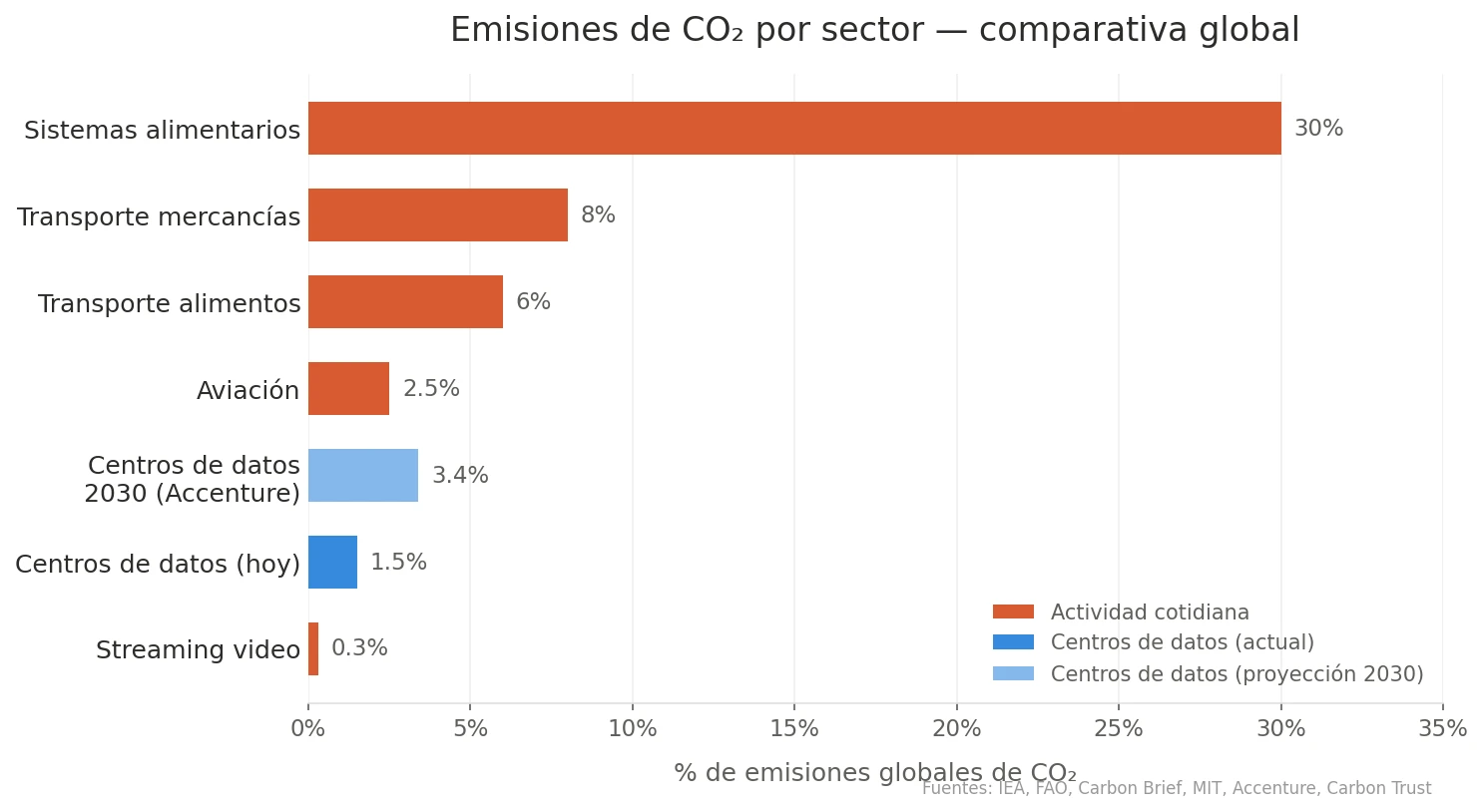
According to the International Energy Agency (IEA), data centers consumed approximately 460 TWh of electricity in 2024 - around 1.5% of global electricity consumption. By 2030, data center CO₂ emissions would reach approximately 1% of global emissions under the IEA’s central scenario, or up to 3.4% according to Accenture’s projections in their base case.
Is that concerning? Yes. But let’s put it in context with things we do every day without blinking:
Global food systems - production, transportation, and waste - account for approximately 30% of all greenhouse gas emissions, according to FAO data updated through 2022. Food transportation alone contributes 6% of total global emissions. The refrigerated trucks carrying your strawberries in January generate nearly double the emissions of growing them.
Aviation accounts for 2.5% of global CO₂ emissions. And yet, almost nobody in the airport queue questions the existence of airplanes.
Freight transport by road, sea, and air adds up to 8% of global emissions, and up to 11% when including warehouses and ports.
Video streaming generates about 55 grams of CO₂ per hour according to the Carbon Trust, and according to an independent analysis by Greenly, total streaming emissions from Netflix, Amazon Prime Video, and Disney+ combined reached around 11 million metric tons of CO₂ in 2024. Not counting YouTube, TikTok, or Spotify.
In summary: data centers account for between 1% and 1.5% of global emissions today. Important, yes. But we are clearly not talking about the only major environmental problem of our era, or even the main one.
The Uncomfortable Mirror
This is where the conversation becomes uncomfortable.
If someone tells me they’re concerned about AI because it harms the planet, I would expect that same environmental concern to show up elsewhere in their life too. Not perfection - that would be absurd - but consistency.
I would expect that same person to question, with equal force, their impulsive consumption, their dependence on motorized transport, their relationship with fast fashion, endless streaming, air conditioning left running unnecessarily, or the comfort of getting anything delivered within 24 hours.
Because the problem is not worrying about AI’s energy footprint. The problem is using that concern selectively, almost surgically, precisely against the technology that most unsettles, alters, or threatens our certainties.
The person criticizing AI for its carbon footprint is probably reading this on a smartphone manufactured in China, shipped by cargo vessel, connected to a global energy-intensive infrastructure, perhaps with the air conditioning running and a show paused in another tab.
I don’t say that to invalidate the criticism. I say it because incoherence also pollutes the debate.
It’s Not Ignorance, It’s Dichotomy
Let me be clear: AI’s energy consumption is a real issue. Tech companies must migrate toward renewable energy and be transparent about their environmental footprint. And many are doing exactly that - according to the IEA, renewables already supply 27% of data center electricity, and will cover nearly half of additional demand over the next five years. Google, Microsoft y Amazon have aggressive clean energy targets for 2030.
That does not absolve anyone. Nor does it mean AI expansion should be beyond scrutiny. On the contrary: we should demand efficiency, transparency, investment in renewables, and real accountability.
But demanding responsibility is one thing, and using the environmental argument as an excuse to belittle, caricature, or slow down a transformation that is already reshaping how we work, learn, and solve problems is something else entirely.
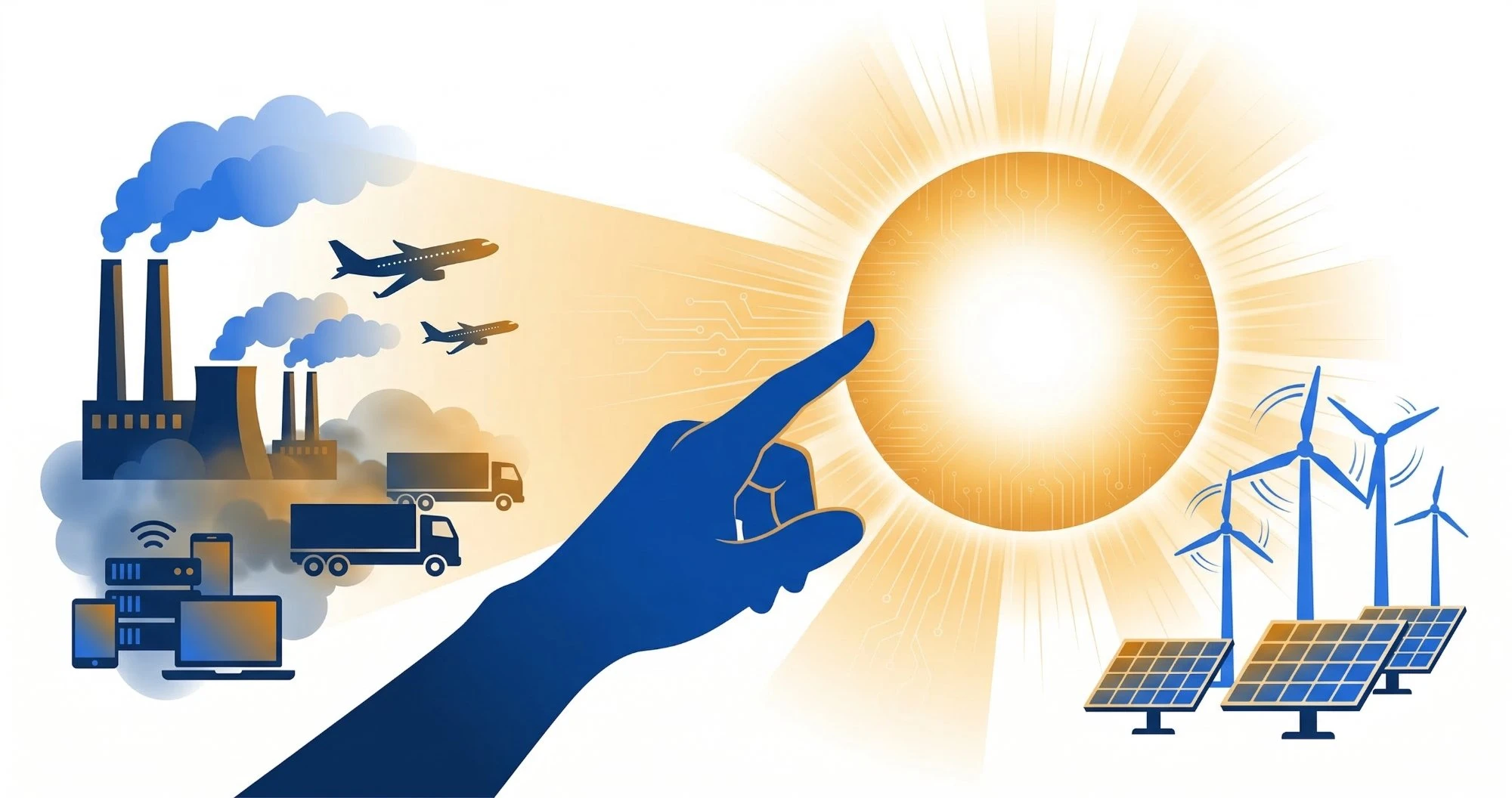
We live in a constant dichotomy: we complain about AI’s energy consumption while doing exactly the opposite in our daily lives. It’s like trying to block the sun with a finger - an elegant way of refusing to acknowledge that something important is happening.
From Land to Intelligence
To understand the magnitude of what we are living through, it’s worth looking back. Emad Mostaque, founder of Stability AI, articulates it clearly in his book The Last Economy: humanity’s economic history can be read as a succession of investments in whatever generates value.
First came Land - whoever controlled the land controlled the world. Entire empires were built on fertile plains.
Then came Labor - the Industrial Revolution proved that organizing production was worth more than owning acres.
Then Capital - when a 13-employee company like Instagram was acquired for a billion dollars, it became clear that value was no longer in factories but in digital networks.
And now comes Intelligence - the capacity to process, create, and solve at a scale that was once exclusively human.
📊 View infographic: The Last Economy - Navigating the Shift to an Intelligent Economy
Each transition was traumatic. Each one generated resistance. And each one reorganized the economic and social power of its time.
Mostaque describes three possible futures: Digital Feudalism, where a handful of corporations control everything; Great Fragmentation, where each nation builds its own isolated AI; and Human Symbiosis, where AI amplifies human purpose.
The third path is the hardest, because it requires us to change. But it is also the only one in which we remain recognizably human.
His estimated window for deciding: approximately one thousand days.
More Human Than Ever
And here is where I want to pause. Because in the middle of all this conversation about technology, energy, and paradigm shifts, there is something we cannot afford to lose sight of: our humanity.
From a perspective of faith - and I speak from my Christian conviction - we have a responsibility to be good stewards of what we have been given. Of creation, yes. But also of our talents, our tools, and our opportunities. The Parable of the Talents does not speak of burying what we are entrusted with out of fear of using it poorly. It speaks of multiplying it.
AI does not make us less human. On the contrary: it confronts us with the question of what makes us human in the first place.
Compassion, creativity, service to others, the capacity to love - those things are not replicated by algorithms. But if a tool frees up time so we can dedicate more of ourselves to what truly matters - being present with our family, serving our community, thinking more deeply - then it is not a threat. It is a gift we must use with wisdom and responsibility.
Now more than ever we need to be more human, not less. Technology amplifies what we already are. If we are selfish, it will amplify our selfishness. If we are compassionate, it will amplify our compassion. The tool does not define the result - the person using it does.
Build, Don’t Obscure
Organizations like AI for Good Foundation are already showing that AI can be a force for good - from humanitarian aid platforms to assistants for refugees, from data catalogs for the Sustainable Development Goals to solutions that put people first.
The IEA itself acknowledges the duality: AI drives electricity demand, but it also has the potential to transform the energy sector - optimizing grids, improving efficiency, and accelerating the discovery of new materials.
We are the bridge generation. The old world is ending. The new one is waiting to be built.
We can spend this time in denial. We can use valid arguments selectively so we don’t have to admit the change has already begun. Or we can enter the hard conversation fully: how to make this technology cleaner, more human, more just, and more useful.
Let us focus our energy on building, not on obscuring what cannot be obscured. Not on dismissing what cannot be dismissed.
The clock is already running.
Article written by Cesar Rosa Polanco - Senior Consultant with 30+ years of experience in infrastructure, security, and automation - with assistance from artificial intelligence as a cognitive amplification tool.